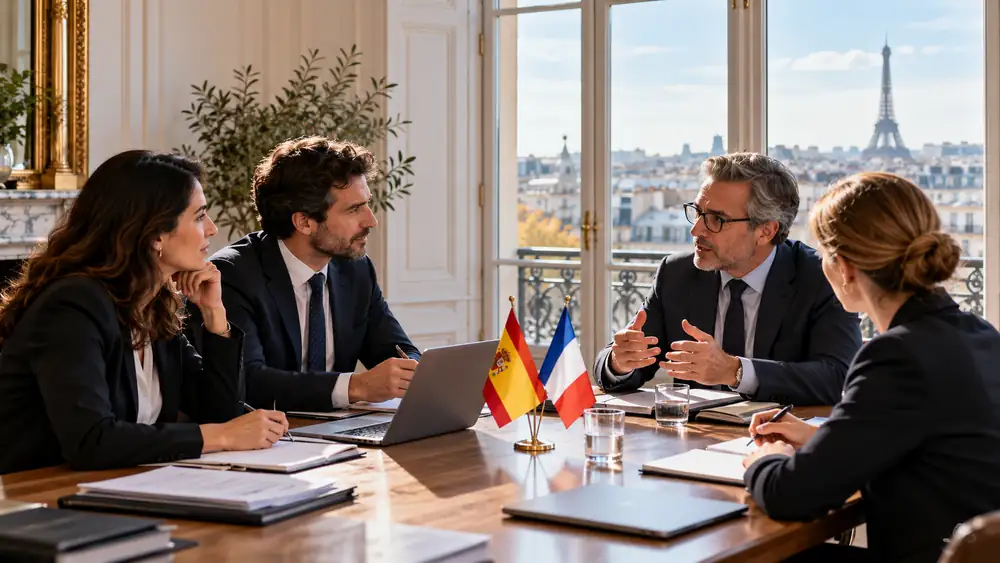
France is Spain’s closest neighbour, both countries belong to the European Union and their companies work together every day. Yet doing business in France can still bring a few surprises for Spanish business leaders. Administrative procedures, formality, meetings, decision-making and even working hours do not always operate in quite the same way. Understanding these differences helps avoid misunderstandings and, more importantly, makes it easier to adapt to the French market.
Of course, this does not mean that every French or Spanish professional works in the same way. Company size, industry, region and generation all have a significant influence. Nevertheless, there are certain professional conventions worth understanding.
1. Doing business in France often involves greater formality
One of the first differences a Spanish business leader may notice is the degree of formality in professional relationships.
In Spain, even in a business environment, people may move relatively quickly to first names and informal forms of address. In France, particularly at a first meeting, the formal « vous » remains common.
A French business email will typically begin with « Bonjour Madame » or « Bonjour Monsieur » and retain a relatively formal tone until a closer relationship has developed.
When in doubt, start formal
When doing business in France, it is generally wise to follow your French counterpart’s lead.
This does not mean that business relationships are cold. Once trust has developed, they can become very friendly. However, becoming overly familiar too quickly can feel inappropriate in some sectors.
If in doubt, allow your French contact to set the tone.
2. French administration rewards preparation
France and Spain both have substantial administrative systems, but Spanish companies entering France encounter a new set of institutions, acronyms and procedures.
Urssaf, INPI, tax authorities, occupational health, supplementary health insurance, collective bargaining agreements and DSN reporting all form part of the French administrative and employment landscape.
A procedure that appears straightforward may also involve several organisations or professional advisers.
Preparing documents in advance saves time
It is good practice to assemble documents before they are needed: the Spanish company’s articles of association, powers of attorney, directors’ identification, beneficial ownership information, VAT numbers and proof of address, for example.
Preparing these documents in advance can significantly simplify procedures and prevent one missing item from delaying the entire project.
3. Business meetings may be more formal
When a company begins doing business in France, its first meetings can play an important role.
French counterparts will generally expect the purpose of a meeting to be clear and participants to understand the subject in detail. Discussions can then be lengthy and highly analytical.
A French counterpart challenging a proposal, pointing out weaknesses or raising numerous objections does not necessarily mean that they oppose the project. Debate can simply form part of the analytical process.
An objection does not necessarily mean rejection
A lively discussion can sometimes be misinterpreted as a negative signal.
In France, testing an idea through arguments and counterarguments can be a way of assessing its strength before reaching a decision.
It is therefore better to prepare figures, documentation and precise answers than to interpret every objection as a lack of interest.
4. Identify who actually makes the decision
French companies can have relatively pronounced hierarchical structures, particularly in traditional or larger organisations. Important decisions are not necessarily taken during the meeting in which they are discussed.
A contact may be enthusiastic about your proposal without having the authority to approve it.
For a Spanish company, it is useful to establish who is involved in the decision and which internal approval stages are required.
Do not mistake a lengthy process for lack of interest
The process may involve several meetings, internal consultations and successive approvals.
Putting excessive pressure on a contact for an immediate answer can be counterproductive. Instead, ask clearly what the next steps are and when a decision can reasonably be expected.
5. Doing business in France requires careful documentation
A compelling presentation matters, but French companies may also expect detailed documentation.
Prices, commercial terms, technical specifications, contracts, deadlines, certifications and responsibilities should be clearly defined.
This is particularly important when doing business in France with larger companies, public-sector organisations or regulated industries.
Your French website also affects your credibility
The first impression may occur long before a meeting.
A French prospect may first visit the Spanish company’s website. A well-written French version, clear legal information, references, contact details and content adapted to the market all help establish credibility.
An obviously machine-translated website can have the opposite effect.
6. Business hours are not quite the same
Daily working patterns in France and Spain still differ.
The French business day generally starts earlier, as does lunch. A 12:30 meeting is perfectly normal for a French business lunch.
A call at 2:30 pm, which may coincide with lunchtime in Spain, falls squarely within the French working afternoon.
These differences may seem minor, but they have practical consequences for teams working across both countries.
Consider the calendar too
July and particularly August can significantly reduce the availability of some French contacts, depending on the sector. Christmas holidays and certain long weekends should also be considered.
Planning an important commercial operation without checking the French calendar can create unnecessary delays.
7. The business lunch still matters
Despite the initially more formal environment, personal relationships also matter in France.
A business lunch remains an excellent opportunity to develop a relationship, discuss a project more freely and build trust. Guides to French business practices also emphasise the role such meetings can play in developing professional relationships.
The timing differs from Spain, however: lunch begins earlier and is generally followed by a return to the working day.
Personal relationships do not replace a strong proposal
A good relationship facilitates business, but it will not normally replace the need for arguments, figures and supporting documentation.
Successful doing business in France therefore involves both personal trust and professional substance.
8. Employment law plays an important role
A Spanish company hiring in France quickly discovers that HR management involves a number of local mechanisms.
Employment contracts, collective bargaining agreements, payroll, social security contributions, occupational health, supplementary health insurance, paid leave and termination procedures all form part of the employer’s environment.
This does not necessarily mean that everything is more complicated. The system simply works differently and has its own rules.
Do not automatically transfer Spanish practices
A contract or practice commonly used in Spain should not automatically be applied to an employee working in France.
Before hiring, the applicable French rules should be identified and the full employment cost calculated.
In certain circumstances, a Spanish company can employ someone in France without establishing a subsidiary, but it must still comply with the corresponding French obligations.
9. French remains a commercial advantage
It is certainly possible to conduct business in English, particularly with international groups, but using French remains a significant advantage when doing business in France.
A website, commercial proposal or contract presented in French demonstrates that the company has made an effort to adapt to the market.
And when dealing with authorities, employees or many local service providers, having a French-speaking point of contact makes procedures considerably easier.
Translation alone is not enough: localisation matters
Localisation does not simply mean replacing Spanish words with French ones.
Sales arguments, forms of address, administrative terminology and even calls to action should be adapted to a French audience.
The same principle applies to everyday communication with customers and partners.
10. A local point of contact can save considerable time
This final difference is practical rather than cultural.
When a company starts doing business in France, it can spend a great deal of time identifying the correct authority, finding the appropriate professional or understanding a procedure it has never encountered in Spain.
Having a point of contact who understands both business environments can remove many of these obstacles.
The aim is not to replace lawyers, tax advisers, accountants or specialists where their expertise is required, but to know whom to contact and how to coordinate the various procedures effectively.
Doing business in France: adapt without losing your identity
France and Spain have a great deal in common, and that is precisely why their differences can sometimes go unnoticed.
A Spanish company does not need to become French to succeed. What matters is understanding market expectations, recognising local conventions and adapting the organisation where necessary.
DA Communication supports Spanish companies looking to grow their business in France, from their first administrative procedures through to employee management, recruitment and coordination with specialist professionals.
Planning to enter the French market? Let’s discuss your project and the solutions best suited to developing it in France.